
We send cat facts by text for a living, which means we are professionally obligated to know a lot of them. This is the big list: one hundred facts, every one real and verifiable, organized so you can binge them or raid them for the perfect thing to text somebody out of nowhere. (That second thing is literally our whole business.)
No myths, no "cats have nine lives" filler. If it's on this list, it's true.
Senses that put ours to shame
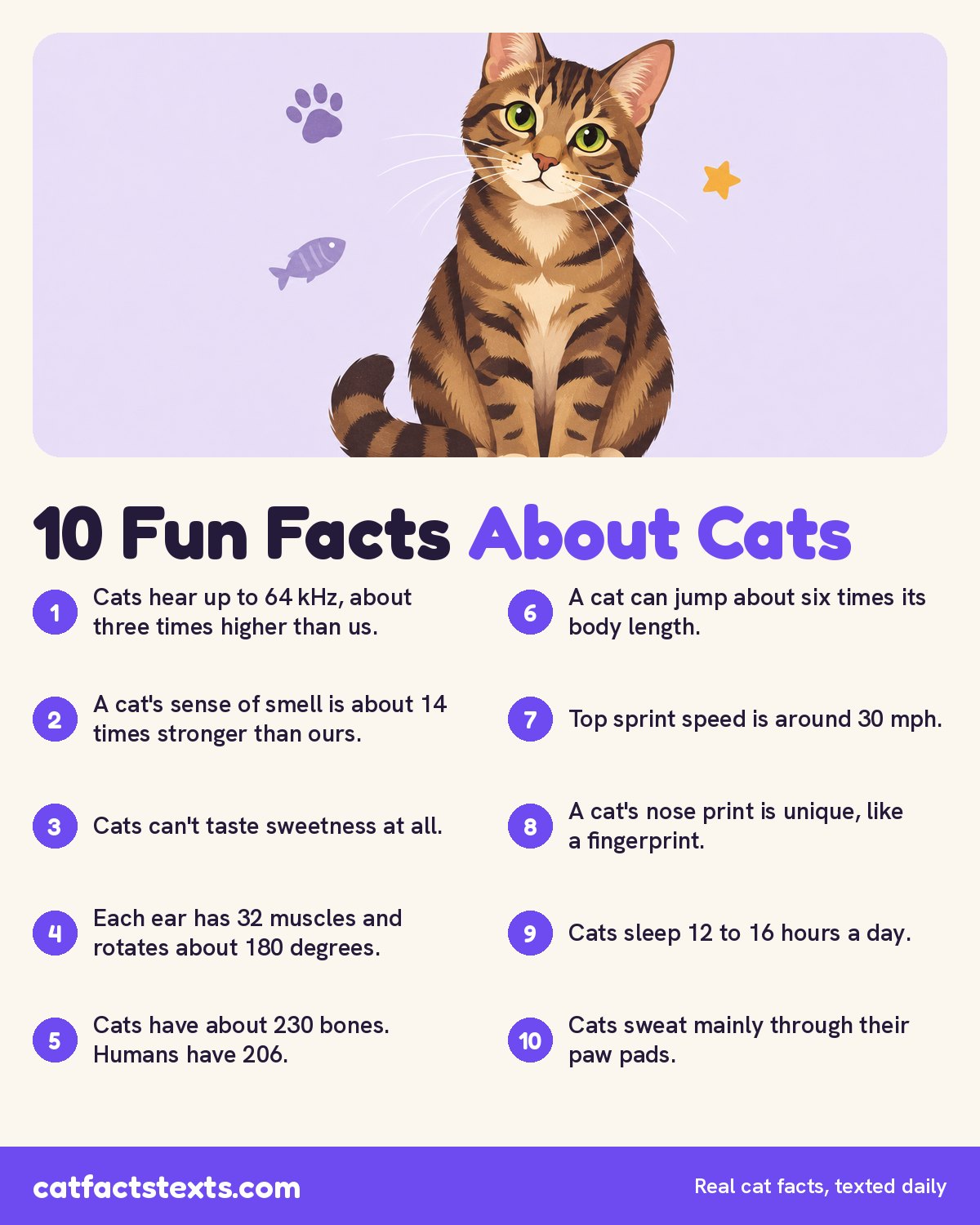
- Cats hear up to about 64 kHz, roughly three times higher than humans. They can hear the ultrasonic squeaks mice use to talk to each other.
- Their sense of smell is about 14 times stronger than ours. Scent, not sight, is how a cat files the world.
- Cats have a second smell organ. The Jacobson's organ sits in the roof of the mouth; that open-mouthed grimace your cat makes is the flehmen response, which is basically tasting a smell.
- A cat needs only about one-sixth of the light we need to see. The mirror layer behind the retina (the tapetum lucidum) is also what makes cat eyes glow in photos.
- A cat's field of view is about 200 degrees. Yours is about 180.
- Cats are nearsighted up close. They can't focus well on anything closer than about ten inches, so whiskers take over at short range.
- Cats have a blind spot right under their nose. That's why the treat you dropped directly in front of them is briefly "lost."
- Cats have about 470 taste buds. Humans have around 9,000.
- Cats can't taste sweetness at all. They're the only mammal known to lack working sweet receptors. The cake begging is about fat, not sugar.
- The standard whisker count is 24, twelve per side in four rows. They're about as wide as the cat's body, they read air currents, and there are more on the backs of the front legs.
Built like a tiny athlete
- Each ear has 32 muscles and rotates about 180 degrees, independently of the other one.
- The collarbone floats free, unattached to other bones. If the head and shoulders fit through a gap, the rest of the cat fits too.
- Cats have about 230 bones. Humans get by with 206.
- Roughly one bone in ten is in the tail, which works like a tightrope walker's pole.
- Cats walk on their toes. The "leg" you see is mostly foot; the actual heel sits up near what looks like a backwards knee.
- Claws are protractible: sheathed by default, deployed on demand. Dogs can't do that.
- Claws curve backward, which is perfect for climbing up and useless for climbing down. That's why descents happen rear-first, or via the fire department.
- The righting reflex is fully developed by about seven weeks old. A falling cat twists the front half, then the back half, and lands feet-down.
- A cat can jump about six times its body length from a standing start.
- Top sprint speed is around 30 mph, faster than Usain Bolt. But cats are pure sprinters; the tank empties in under a minute.
The weird biology
- Cats sweat mainly through their paw pads. On a hot day you can sometimes spot damp little pawprints.
- A cat's nose print is unique, like a human fingerprint.
- Cats have a third eyelid, the nictitating membrane, which sweeps sideways across the eye.
- The sandpaper tongue is covered in backward-facing hooks made of keratin, the same material as the claws.
- Cats lap about four times a second, pulling up a column of water with inertia. MIT researchers actually studied the physics.
- Normal cat body temperature is 101 to 102.5°F, warmer than yours, which is why a lap cat feels like a small heater.
- A resting cat heart runs 140 to 220 beats per minute, roughly double a human's.
- Most adult cats are lactose intolerant. The classic saucer of milk is a myth with digestive consequences.
- Cat kidneys are efficient enough to survive on seawater. Please do not test this.
- Cats, camels, and giraffes share a gait: both left legs move, then both right legs. Almost nobody else walks that way.
Sleep, glorious sleep
- Cats sleep 12 to 16 hours a day. Kittens and seniors can push 20.
- About 70 percent of a cat's life is spent asleep.
- Cats aren't nocturnal, they're crepuscular: built for dawn and dusk. Hence the 5 a.m. concert.
- Cats dream. During REM sleep the whiskers and paws twitch, most likely replaying the day's events.
- Newborn kittens sleep about 90 percent of the time.
- Zoomies have a scientific name: frenetic random activity periods, or FRAPs.
- The loaf is a good sign. Tucked paws mean your cat has no immediate plans to run anywhere.
- Cats rotate their favorite sleeping spots on a loose schedule, like a timeshare only they understand.
- Boxes measurably reduce cat stress. Shelter studies found new cats with hiding boxes settled in faster.
- Even a square of tape on the floor works. In a 2021 citizen-science study, cats sat inside the mere illusion of a box.
How cats talk
- Cats can make over 100 distinct vocal sounds. Dogs manage about ten.
- Adult cats meow almost exclusively at humans. Between themselves, they mostly drop it after kittenhood. The meow persists because it works on us.
- The "feed me" purr hides a cry. Researchers found cats embed a frequency close to a baby's cry inside their solicitation purr. It is extremely effective and they know it.
- Purrs vibrate at 25 to 150 Hz, a frequency range that studies have linked to bone and tissue healing.
- Cats also purr when stressed, hurt, or at the vet. It's self-soothing, not just happiness.
- The chattering at birds is excitement and frustration, and possibly a rehearsal of the killing bite.
- A tail held straight up is a friendly greeting. The little quiver at the top is peak excitement.
- The slow blink is real. It signals trust, and studies show that slow-blinking back at a cat actually works.
- Airplane ears mean annoyed. And each ear keeps tracking sounds independently, even mid-nap.
- A hiss needs no translation. Cats understand it from birth; it's universal feline for "back up."
Affection, scent, and social life
- Headbutting is called bunting, and it deposits scent from glands on the face. You've been claimed, in a nice way.
- Cats carry scent glands in their cheeks, paws, and tail base. All that rubbing is your cat signing its name on you.
- Kneading is a leftover from nursing, when it stimulated milk flow. It stays for life as a comfort behavior.
- Cats groom each other to bond. It's called allogrooming, and a lick from your cat counts.
- Grooming takes up 30 to 50 percent of a cat's waking hours.
- The dead mouse on your pillow is social behavior: sharing the hunt with family. You, in this scenario, are the family.
- Covering waste is territory etiquette, a habit from sharing space with bigger, scarier cats.
- Scratching is a billboard: a visible mark plus scent from paw glands, posted where everyone will see it.
- Cats know their names. A 2019 study confirmed they recognize them; responding remains optional.
- Cats form secure attachments to their people, the same bond pattern human infants show. That was measured in a 2019 study too.
Kitten facts
- Kittens are born blind and deaf. Eyes open at around 7 to 10 days.
- Almost all kittens are born with blue eyes. Adult eye color settles in by two to three months.
- The collective nouns are perfect: a kindle of kittens, a clowder of cats.
- One litter can have multiple fathers. It's called superfecundation.
- Kittens get 26 baby teeth, later replaced by 30 adult ones.
- The socialization window is 2 to 7 weeks. Kittens handled gently during it usually grow into people-loving cats.
- Kittens purr within days of birth, first as a way to communicate with mom while nursing.
- Play is hunting school. Every pounce on a sibling is stalk-and-kill practice.
- The largest recorded litter was 19 kittens.
- Cat years aren't linear. Year one is roughly 15 human years, year two adds about nine, then it's about four per year.
Coats and genetics
- Orange lives on the X chromosome, which is why about four in five orange cats are male. (More on that in our orange cat facts deep dive.)
- Every orange cat is a tabby. A truly solid orange cat doesn't exist; the stripes always show.
- Calicos and torties are almost all female. A male calico is roughly a 1-in-3,000 event and usually sterile.
- Every tabby wears an "M" on its forehead. Folklore offers a dozen explanations; genetics just calls it the tabby mark.
- Siamese coloring is temperature-sensitive. The cooler parts of the body go dark, and the kittens are born all white.
- White cats with blue eyes have high rates of congenital deafness, a quirk of the same gene doing both jobs.
- Odd-eyed cats are usually white-coated. One blue eye, one gold or green, and completely healthy in most cases.
- Twenty-two cat breeds can be black, but the Bombay is black only, bred on purpose to look like a pocket panther. (There's a whole black cat facts list too.)
- Black cats can "rust." Strong sunlight breaks down the pigment and reveals a reddish-brown tint.
- Domestic cats share about 95.6 percent of their DNA with tigers. The remaining 4.4 percent is why you're alive.
Cats and human history
- Cats domesticated themselves around 10,000 years ago, moving in on the mice around early farmers' grain stores and never leaving.
- The oldest known pet cat was buried beside its human in Cyprus about 9,500 years ago.
- Ancient Egyptians shaved their eyebrows to mourn a family cat, and the goddess Bastet had a cat's head. The full story is wild.
- Egypt once banned exporting cats. People smuggled them out anyway, which is how the rest of the world got them.
- Vikings kept ship cats, and today's Norwegian Forest cat descends from that fleet.
- The first modern cat show ran at London's Crystal Palace in 1871.
- Abraham Lincoln kept the first White House cats, Tabby and Dixie.
- Nineteenth-century post offices kept cats on the payroll to protect the mail from rats, including in New York City.
- The Hermitage Museum in Russia has employed guard cats since 1745, by imperial decree.
- The first cat café opened in Taipei in 1998, then the idea conquered Japan and everywhere else.
Famous cats and world records
- The oldest cat ever, Creme Puff of Texas, lived 38 years and 3 days.
- Stubbs served as honorary mayor of Talkeetna, Alaska, for about 20 years.
- Larry holds the official title Chief Mouser to the Cabinet Office at 10 Downing Street, and has now outlasted a long line of prime ministers.
- Towser, a Scottish distillery cat, caught 28,899 mice, a Guinness World Record.
- Félicette, a French cat, went to space in 1963 and came back. She remains the only cat ever to make the trip.
- Simon of HMS Amethyst is the only cat to win the Dickin Medal, the animal world's highest military honor.
- The first cloned cat, CC ("Copy Cat"), arrived in 2001. Famously, her coat pattern didn't match her donor's. Genetics kept a little mystery.
- The CIA once tried to turn a cat into a listening device. The 1960s "Acoustic Kitty" project is real, declassified, and was a complete flop.
- A Siamese cat co-authored a physics paper. F.D.C. Willard shared the byline on a 1975 paper after his human wrote "we" throughout and needed a second author.
- The oldest cat film is from 1894: Thomas Edison's studio shot "Boxing Cats." Cats have been on camera, and winning, ever since.
Now do something fun with them
You made it to 100, which officially makes you the cat facts person in your friend group. There are two ways to go from here.
The manual way: raid this list, plus our funny, weird, and sounds-fake-but-true collections, and text your favorites to someone one at a time.
The professional way: let us do it. Enter a friend's number, pick how many facts a day, and a real cat fact lands in their texts every single day until they figure out who did this to them. It's the internet's favorite harmless prank, and it started with one legendary Reddit thread.
Reply STOP anytime and the facts stop. (But honestly, nobody ever does.)