
You live with a tiny predator who chose your couch over the wild, ignores your name on purpose, and occasionally stares at a wall like it owes them money. The more you learn about cats, the more it feels like they were beamed in from somewhere else. The best part? You don't need to make anything up. The real facts are strange enough on their own. Here are fifteen genuinely weird, genuinely true ones.
Their bodies run on alien hardware
Start with the machinery, because that's where cats get truly bizarre.
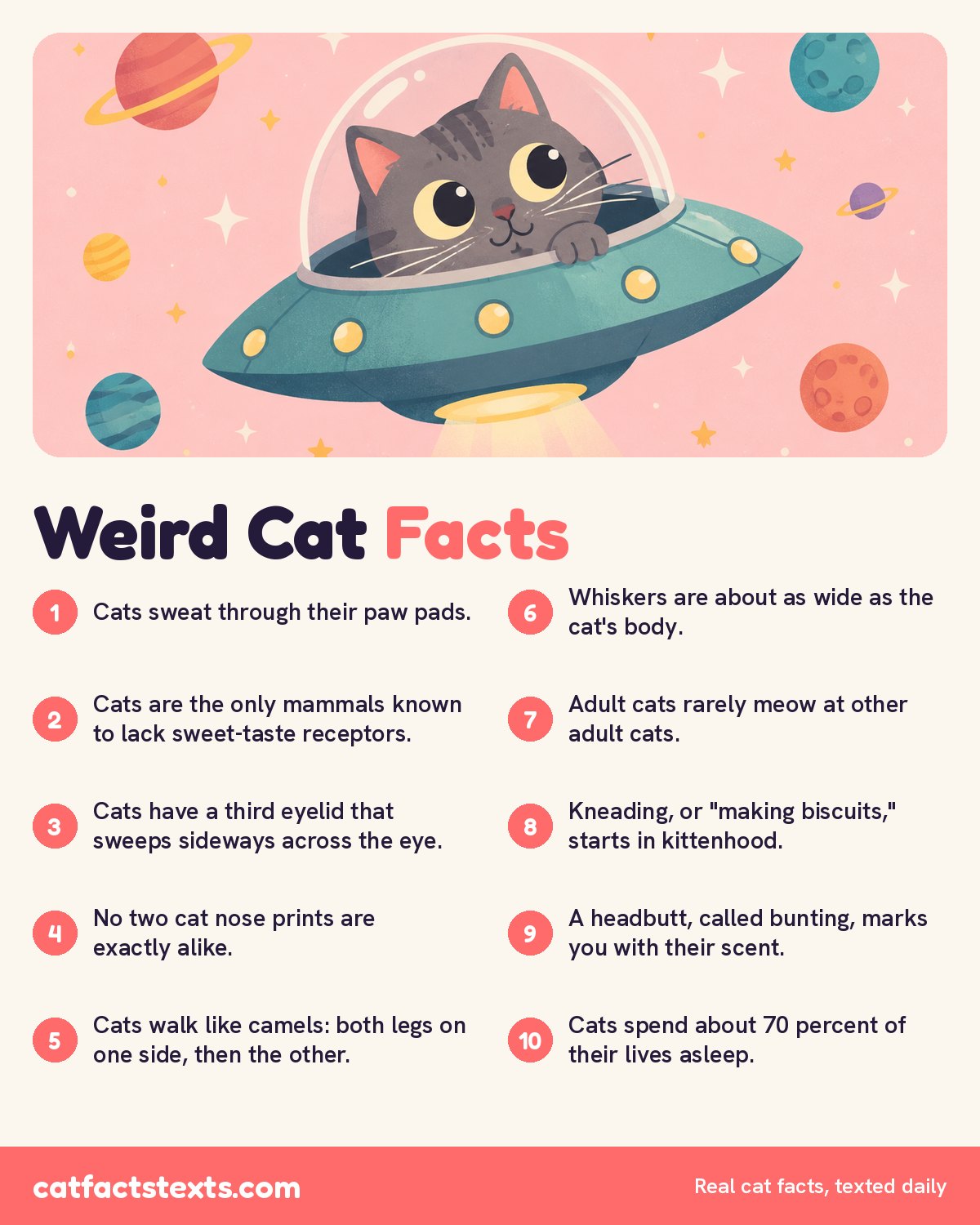
- They sweat through their paws. Cats have almost no sweat glands across the rest of their body. On a hot or stressful day, the cooling happens through the pads of their feet, which is why you might spot faint damp paw prints on a smooth floor.
- They can't taste sweetness. Cats are the only mammals known to lack working sweet-taste receptors. That bit of frosting they begged for? They're chasing the fat and protein, not the sugar. Sweet simply doesn't register.
- They have a third eyelid. It's called the nictitating membrane, and it sweeps sideways across the eye to keep it moist and protected. If you can see it while your cat is wide awake, that's usually a sign to call the vet.
- Their nose print is one of a kind. Like a human fingerprint, no two cat nose prints share the exact same pattern of ridges and bumps.
- They walk like camels. Cats move both legs on one side, then both legs on the other. Only a small handful of animals, including camels and giraffes, share that pacing gait.
Their senses are tuned to another channel
A cat experiences the room very differently than you do, and the gap is wider than most people realize.
- Their whiskers are built-in measuring tape. Whiskers tend to be about as wide as the cat's body, helping them judge in the dark whether a gap is too narrow to squeeze through. They're sensory tools, not decoration.
- Each ear has dozens of muscles. A cat can rotate its ears independently, swiveling them toward a sound to pinpoint exactly where it came from. Humans, by comparison, mostly just have ears that sit there.
- They see beautifully in near darkness. Cats need only a fraction of the light humans do to navigate a room, thanks to a reflective layer behind the retina called the tapetum lucidum. That same layer is why their eyes glow in a camera flash.
- Their hearing reaches well past ours. Cats can detect very high-pitched sounds far above the range people can hear, which is part of why they pick up on a rodent in the walls long before you do.
Here's a quick way to picture how much of a cat's world is invisible to you:
- They hear frequencies you can't.
- They see in light levels you'd call pitch black.
- They map space with whiskers you don't have.
- They smell layers of information you'll never notice.
No wonder they sometimes seem to be reacting to a ghost. They're reacting to a channel you can't tune into.
Their behavior breaks the rules
This is where the alien theory really gains steam.
- The slow blink is a love letter. When a relaxed cat looks at you and slowly closes and opens its eyes, that's a sign of trust and affection, sometimes called a cat kiss. Try slow-blinking back and watch what happens.
- They headbutt you on purpose. That gentle bonk against your hand or face is called bunting. Cats have scent glands on their cheeks and head, and bunting marks you as part of their safe inner circle. It's a compliment.
- They meow mainly for you. Adult cats rarely meow at other adult cats. They mostly reserve that sound for humans, having figured out it's a reliable way to get our attention. They essentially developed a language aimed at us.
- They knead like they never grew up. That rhythmic pressing of the paws, often called making biscuits, traces back to kittenhood and nursing. Grown cats keep doing it when they feel calm and content.
They were treated like visitors from above
- Ancient Egyptians revered them. Cats were deeply respected in ancient Egypt, associated with protection and grace, and harming one was treated as a serious offense. People mourned a lost cat the way they'd mourn family.
- They sleep most of their lives away. Cats commonly sleep somewhere in the range of twelve to sixteen hours a day. Stack that up over a full lifetime and your cat spends the majority of its existence napping, conserving energy like a creature that knows it's only visiting.
So, aliens?
Probably not, technically. But a small, warm, purring animal that can't taste sugar, sweats through its feet, sees in the dark, talks only to you, and sleeps two-thirds of its life is at least alien-adjacent. The weirdest thing of all might be that we get to share our homes with them.
If this list scratched an itch, there are plenty more cat facts where these came from. And if you'd rather get one delivered to your phone every day instead of scrolling for them, that's exactly what we do.
Know someone who'd love a daily dose of feline weirdness? Start sending cat facts to their number and let a strange new fact show up every morning. It lands somewhere between a harmless prank and a genuinely thoughtful gift, and they can always reply STOP to cancel anytime, no hard feelings.