
Cats are tiny, fluffy comedians who have no idea they're funny, which is exactly what makes them funny. They sprint across the house at 3 a.m. for no reason, judge you from the top of the fridge, and somehow weaponize a single slow blink. Here are thirty-seven real, well-documented facts and quirks about cats that range from "huh, neat" to "I can't believe that's actually true." Not a single one is made up. The cats did all this on their own.
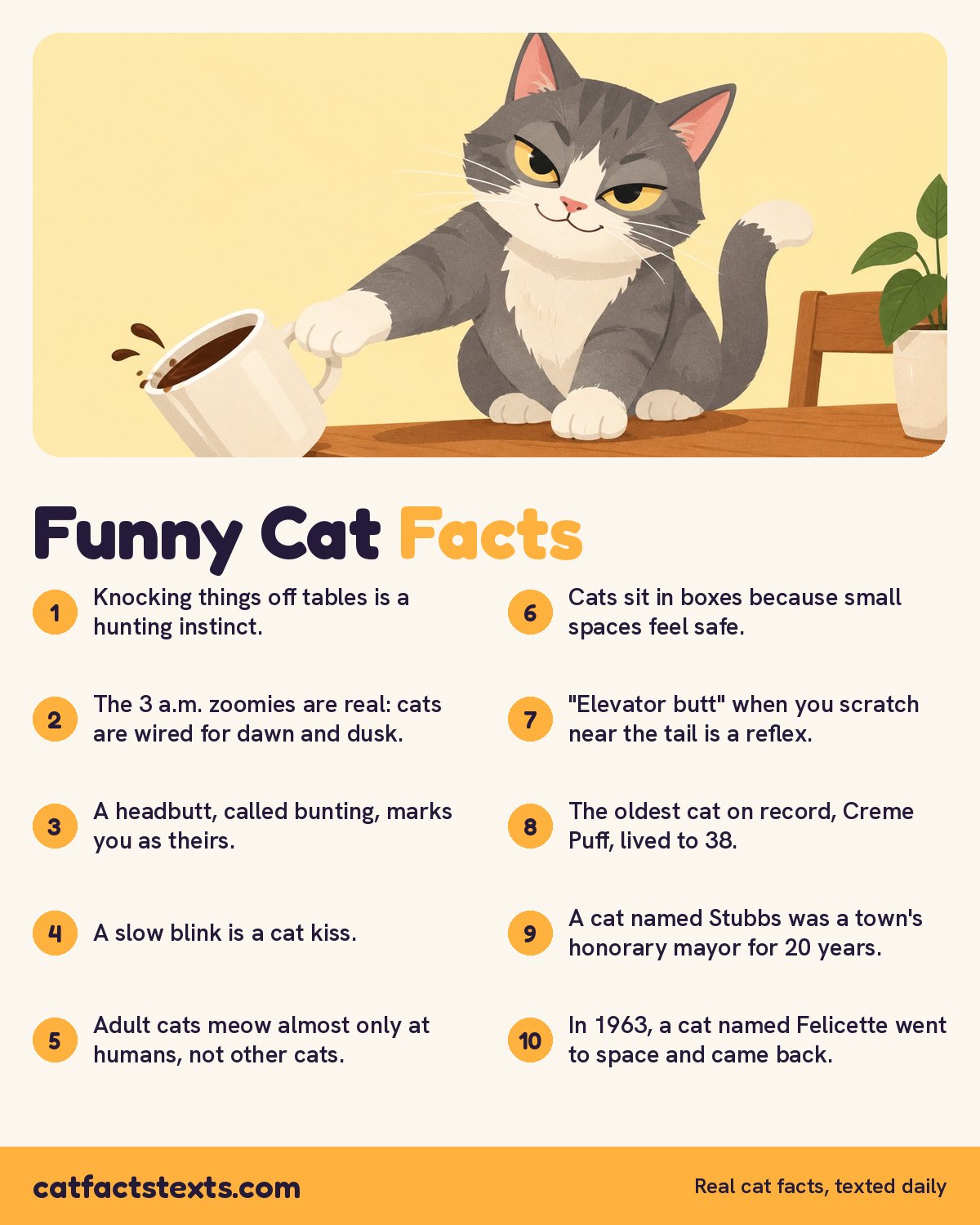
The everyday chaos
You live with this. You just may not have known it had a name.
- Cats knock things off tables on purpose. Pawing an object until it falls is a hunting instinct. They're testing whether the thing is alive. Your coffee mug failed the test.
- The 3 a.m. zoomies are real. Cats are crepuscular, meaning they're naturally most active at dawn and dusk. Your bedroom is just the racetrack that happens to be available.
- Loaf mode is a thing. When a cat tucks all four paws beneath its body, it's conserving heat and signaling it feels safe. A relaxed cat is, technically, bread.
- They headbutt you to claim you. It's called bunting, and it deposits scent from glands on their face. Congratulations, you've been marked as property.
- The slow blink is a cat kiss. A slow, lazy blink is a genuine sign of trust and affection. Blink back slowly and you're officially flirting.
- Cats "chatter" at birds through the window with a rapid teeth-clicking sound. It may be excitement, frustration, or a rehearsal of the killing bite they'll never get to use.
The body is the joke
A cat's hardware is built for ambush and comedy in roughly equal measure.
- Cats can't taste sweetness. They're the only mammals known to lack functional sweet-taste receptors, so they are physically incapable of caring about your dessert.
- They sweat through their paws. With almost no sweat glands elsewhere, a hot, stressed cat may leave faint damp paw prints on the vet's table.
- Whiskers are a built-in tape measure. They're roughly as wide as the cat's body, helping it judge whether a gap is too narrow. This does not stop cats from getting stuck in things anyway.
- A cat has 32 muscles in each ear (humans have six) and can rotate each ear independently, which is why they can ignore you with such precision.
- Cats have a third eyelid, the nictitating membrane, that sweeps across the eye for protection. It's also why a sleepy cat sometimes looks mildly possessed.
- A cat's nose print is unique, like a human fingerprint. No two are exactly alike, not that any cat has ever consented to being printed.
- Most calico and tortoiseshell cats are female. The genetics behind those coats are tied to the X chromosome, so a male calico is a genuine rarity.
They are talking to you specifically
Cats are quietly running a long con on the human species, and it's working.
- Adult cats meow almost exclusively at humans, not at each other. They figured out it gets results and never looked back.
- The purr is a multitool. Cats purr when content, but also when injured, anxious, or giving birth. The vibration may help them self-soothe.
- Some cats have a "solicitation purr" for mealtimes that mixes in a higher, more urgent cry. Studies have found people find it harder to ignore. You've been engineered.
- Cats can make a huge range of vocal sounds, well over a hundred, while dogs manage only around ten. Your cat has a bigger vocabulary than you give it credit for.
- A meow held for an extra beat usually means "now." The longer the demand, the more serious the cat.
The legends and record-holders
Real cats, real records, real proof that the universe has a sense of humor.
- The oldest cat on record lived to 38: that's Creme Puff, from Texas, who outlived most family pets several times over.
- A cat named Stubbs was the honorary mayor of Talkeetna, Alaska, for about 20 years. The town's approval rating for him was reportedly excellent.
- A cat named Felicette went to space in 1963 and came back: the first and only cat to do so. She was extremely unimpressed, presumably.
- Isaac Newton is credited with inventing the cat flap, allegedly to stop his cats from scratching at the door while he was busy inventing physics.
- The largest recorded litter was 19 kittens. Fifteen survived. The mother cat has earned every nap since.
More quirks that sound fake
- Cats spend a huge portion of the day grooming: a clean coat helps with scent control and temperature, and apparently with looking flawless while ignoring you.
- A cat's "elevator butt", lifting the rear when you scratch near the tail, is an involuntary reflex, not a personal review of your technique.
- Cats often sit in boxes (and in taped-out squares on the floor) because enclosed spaces feel secure. A box is a stress ball you can sleep in.
- Kneading with their paws, sometimes called "making biscuits," is a leftover kittenhood comfort behavior tied to nursing. Pure contentment, occasionally with claws.
- Cats walk like camels and giraffes, moving both legs on one side, then both on the other: a gait only those three animals share.
- A relaxed, upright tail with a little hook at the tip is the feline equivalent of a cheerful "oh, hey, it's you."
That's a solid handful past thirty-seven if you count generously, which is the only correct way to count cats. Want more? We've got plenty of more cat facts where these came from.
Send the funny straight to a phone
Here's the thing: a cat fact lands even better as a surprise text than it does in a blog. That's the entire premise of Cat Facts Texts. Pick a number, pick how many facts a day, and we text a real, verified cat fact to that lucky human (or unsuspecting victim) every morning.
It's the rare prank that turns into a gift people actually look forward to. Start sending cat facts to a friend, a coworker, or yourself, and if anyone ever decides they've reached peak feline knowledge, they can reply STOP to cancel anytime. Nobody ever does.