
Cats are one of the most curious, cuddly, and downright surprising animals around, which makes them perfect for curious kids. Whether your little one is doing a school report, asking a hundred questions at dinner, or just loves the neighborhood cat, here are twenty-five real cat facts that are simple enough to understand and cool enough to share at show-and-tell.
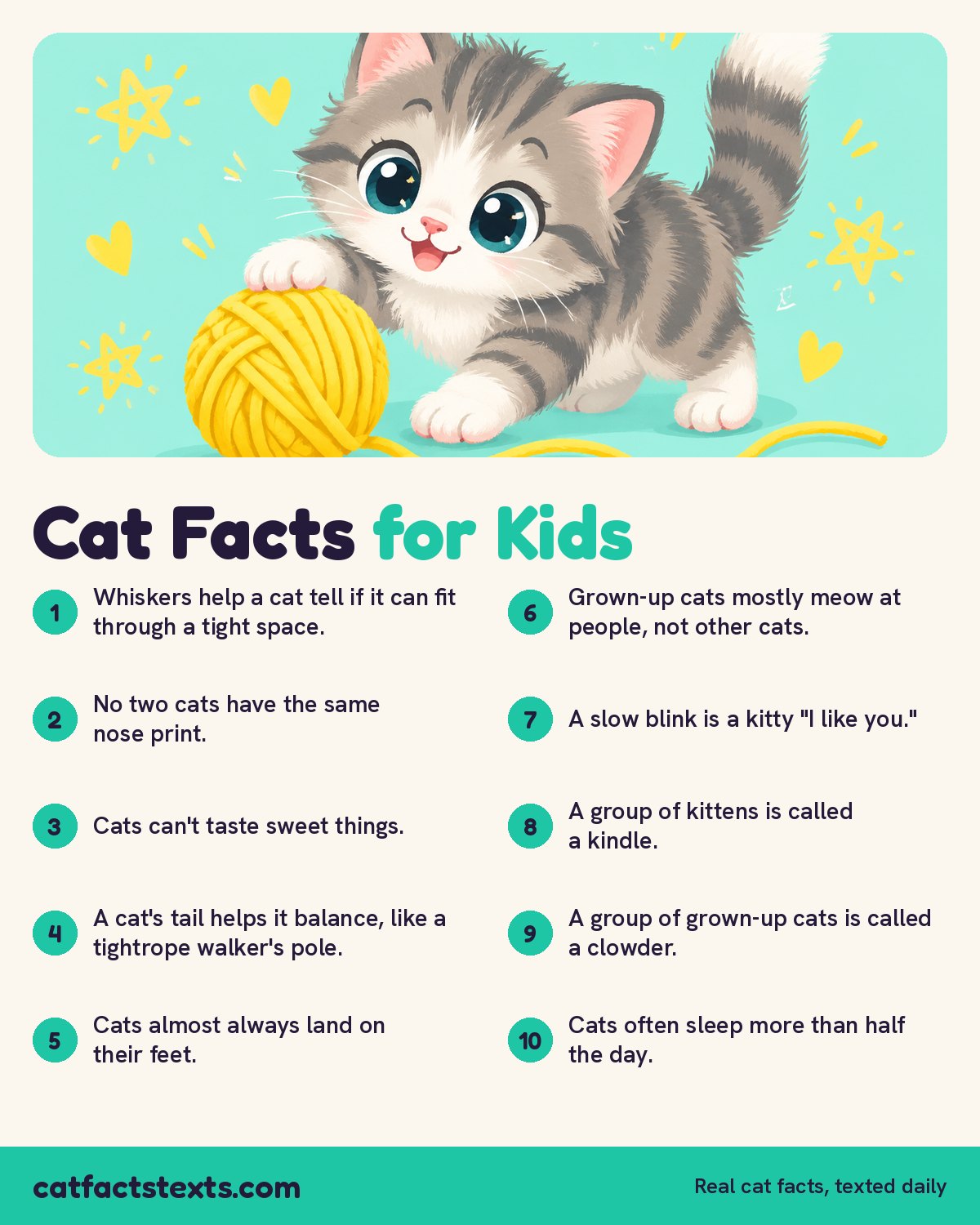
Every fact here is true and age-appropriate. Read them out loud, quiz each other, and see which one gets the biggest "Whoa, really?"
Fun facts about a cat's body
Cats may look like fluffy little couch potatoes, but their bodies are built for amazing things.
- A cat has whiskers that help it feel the world. Whiskers aren't just for looks. They help a cat figure out if it can fit through a tight space.
- Cats can rotate their ears almost all the way around. Lots of tiny muscles let them point their ears toward a sound, which is how they always seem to know when you open a can of food.
- A cat's nose is one of a kind. Just like your fingerprints, no two cats have the same nose print.
- Cats can't taste sweet things. A cat won't care about your candy or cookies. They're built to love meat instead.
- Cats have soft pads on their feet. Those squishy paw pads help them walk quietly so they can sneak up on their toys (and sometimes on you).
- A cat's tail helps it balance. When a cat walks along a narrow ledge or fence, its tail works like a tightrope walker's pole.
How cats move and play
If you have ever watched a cat zoom around the house for no reason, you already know they are full of energy.
- Cats are great jumpers. Many cats can leap several times their own length, which is like you jumping across a whole room.
- Cats can run very fast for short distances. A house cat can break into a quick sprint when it wants to.
- Cats almost always land on their feet. They have a special "righting reflex" that helps them twist in the air. (Still, cats can get hurt from falls, so this isn't a superpower.)
- Cats love to climb. In the wild, climbing helps cats stay safe and spot their next meal from up high.
- Kittens learn by playing. When kittens pounce and wrestle, they're practicing the skills wild cats use to hunt.
How cats talk to us
Cats have lots of ways to tell us how they feel, and once you learn them, it's like speaking a secret language.
- Grown-up cats mostly meow at people, not other cats. They learned that meowing is a great way to get our attention.
- A purr usually means a cat feels happy or calm. Sometimes cats also purr to comfort themselves when they're nervous.
- A slow blink is a kitty "I like you." If a cat looks at you and slowly closes its eyes, try slowly blinking back.
- Cats can make many different sounds. Meows, chirps, trills, and even funny chattering noises at birds outside the window.
- When a cat rubs its head on you, that's a compliment. It's leaving its scent to say "you're part of my family."
- A puffed-up tail means a cat is scared or surprised. It makes them look bigger so they feel braver.
Cats around the world and through time
Cats have been hanging out with humans for a very, very long time.
- People have loved cats for thousands of years. Long ago in ancient Egypt, cats were treated as special and very important animals.
- A baby cat is called a kitten. And a group of kittens is called a kindle.
- A group of grown-up cats is called a clowder. It's a funny word that's fun to say out loud.
- There are many breeds of cats. Some have long fluffy fur, some have short fur, and a few have almost no fur at all.
- Cats come in lots of colors and patterns. Stripes, spots, patches, and swirls. A striped pattern is often called "tabby."
Cats are champion nappers
Here's the fact most kids love best.
- Cats sleep a lot, often more than half the day. All that napping helps them save energy for play and zoomies.
- Cats like cozy, warm spots. That's why they curl up in sunny windows, laundry baskets, and your favorite chair.
- Cats groom themselves to stay clean. Their tongues feel rough like sandpaper, which helps them brush their own fur.
A few gentle reminders for kid cat-lovers
Loving cats also means being kind and careful with them. Here are a few simple things every young animal friend should remember:
- Always be gentle, and let a cat come to you instead of grabbing it.
- Give a cat space when it's eating, sleeping, or hiding.
- Wash your hands after petting or cleaning up after a cat.
- Ask a grown-up before feeding any cat new food, since some human foods aren't safe for them.
Cats are wonderful companions, and learning about them helps us take better care of them. If your little human can't get enough, there are always more cat facts to explore together.
Share a daily cat fact with your kid
Want a fun, easy way to keep the cat facts coming? You can start sending cat facts straight to a phone, so your family gets a new wholesome cat fact to giggle over every single day. It's a sweet little surprise for a cat-loving kid, grandparent, or teacher, and you can reply STOP to cancel anytime if you ever need a break.