
Cats are not subtle. They just speak a language most of us never bothered to learn. A flick of the tail, a slow blink, a single ear swiveling backward: these are full sentences, and your cat is talking constantly. Once you know what to look for, living with a cat goes from guesswork to genuine conversation. Here is a practical, accurate field guide to reading the signals.
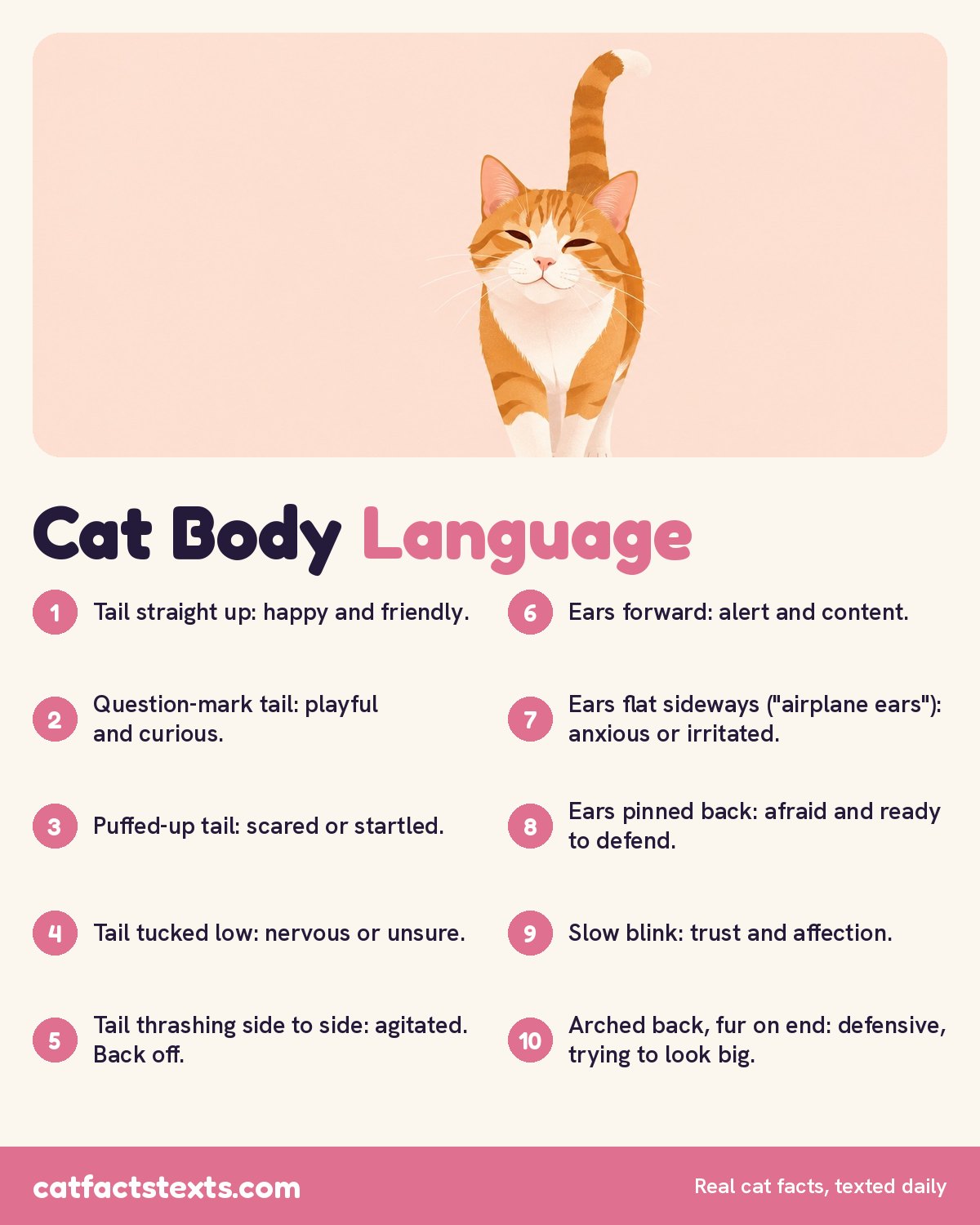
Start with the tail
The tail is the easiest place to begin because it is big, expressive, and hard to misread once you know the basics. Think of it as a mood antenna.
- Straight up, tip relaxed: Confidence and friendliness. A cat that walks toward you with its tail held high is happy to see you. A little hook or quiver at the very tip is the feline equivalent of a delighted hello.
- Puffed up like a bottle brush: Fear or aggression. The cat is trying to look bigger because something startled or threatened it. Give it space.
- Tucked low or wrapped under the body: Nervousness, submission, or discomfort. The cat wants to take up less room.
- Swishing or thrashing side to side: Agitation or overstimulation. This is not the wag of a happy dog. A lashing tail usually means "I'm done now," and it often comes right before a swat.
- Slow, gentle twitch at the tip: Mild interest or focus. You will see this when your cat is watching a bird through the window.
- Question-mark or hook shape: Playful and curious. A good moment to grab a toy.
A wagging tail on a cat means the opposite of what it means on a dog. When in doubt, slow down.
Read the ears
Cats have remarkably mobile ears, and they point them like little satellite dishes toward whatever has their attention. Position tells you a lot.
- Forward and upright: Alert, interested, content. This is the default "all is well" setting.
- Swiveling around: The cat is tracking sounds and gathering information. Normal and curious.
- Flattened sideways ("airplane ears"): Anxiety or irritation. The cat is conflicted or feeling defensive.
- Pinned flat back against the head: Fear or readiness to defend itself. This is a strong "back off" signal. Combined with a puffed tail, it means the cat feels genuinely threatened.
Ears rarely lie, and they react fast. If you watch nothing else during play, watch the ears for the moment fun tips into too much.
The eyes have it
Eyes are where some of the sweetest cat communication happens, along with some of the clearest warnings.
The slow blink
If your cat looks at you and slowly closes and opens its eyes, you are being paid a high compliment. The slow blink is often described as a cat "kiss": a signal of trust and relaxation, since closing the eyes near another creature means letting your guard down. Try slow-blinking back. Many cats will return the gesture, and it is one of the simplest ways to tell your cat you are friendly.
Pupils
- Narrow slits in normal light usually mean a calm, confident cat. In bright light, of course, slits are just the eyes adjusting.
- Wide, dilated pupils can signal excitement, playfulness, fear, or surprise. Read them alongside the body. Big eyes during play are normal arousal. Big eyes paired with a low crouch and flat ears mean fear.
- A hard, unblinking stare is not affection. Between cats, a direct stare is a challenge. If a strange cat locks eyes with yours, that is tension, not a staring contest for fun.
Posture and the whole picture
No single body part tells the full story. The trick is reading the whole cat at once.
- Loose and relaxed, maybe lying on its side: A comfortable cat. A cat that exposes its belly is showing real trust, though that is not always an invitation to rub it. For many cats the belly is a vulnerable spot, and reaching for it earns a polite (or impolite) grab.
- Crouched low, weight gathered, tail tucked: A scared or wary cat trying to stay small and ready to flee.
- Arched back with fur on end: The classic "Halloween cat." It is a defensive display meant to look as large and intimidating as possible.
- Rubbing against your legs or head-bumping you: This is called bunting, and it deposits scent from glands on the face. Your cat is marking you as part of its trusted territory. Take the compliment.
- Kneading with the paws: A leftover kitten behavior tied to nursing, now a sign of contentment. The cat feels safe and cozy.
When you put it together, a cat with upright ears, a high tail, soft eyes, and a relaxed body is telling you everything is good. A cat with flat ears, a puffed tail, dilated eyes, and a low crouch is telling you the opposite, loudly.
A few honest caveats
Body language is context, not a strict code. Breed, personality, and the specific situation all shape how a cat behaves, and every cat has quirks. A tail twitch from one cat might mean delight and from another mean "enough." The goal is not to memorize a rulebook but to learn your particular cat. Watch what each signal tends to lead to, and over time you will read your cat as easily as you read a close friend's face.
And when a signal seems off, whether sudden hiding, a third eyelid showing while awake, or changes in posture that come with eating or litter-box trouble, that is a reason to call your vet, not to consult a chart. Body language helps with moods, not medicine.
If this sparked your curiosity about all things feline, we have plenty more cat facts where this came from.
Keep the cat facts coming
Reading your cat is a skill that rewards a steady diet of cat knowledge, and a daily fact is a painless way to build it. Start sending cat facts to your favorite cat person, or to a friend who could use a daily dose of feline trivia whether they asked for it or not. Pick a number, pick how many facts a day, and we handle the rest. They can reply STOP to cancel anytime, or unsubscribe in a tap. Most people never do.